Edge Deployment Is Now a Core SEO Skill. Here’s Why Your Next.js Site Needs It.
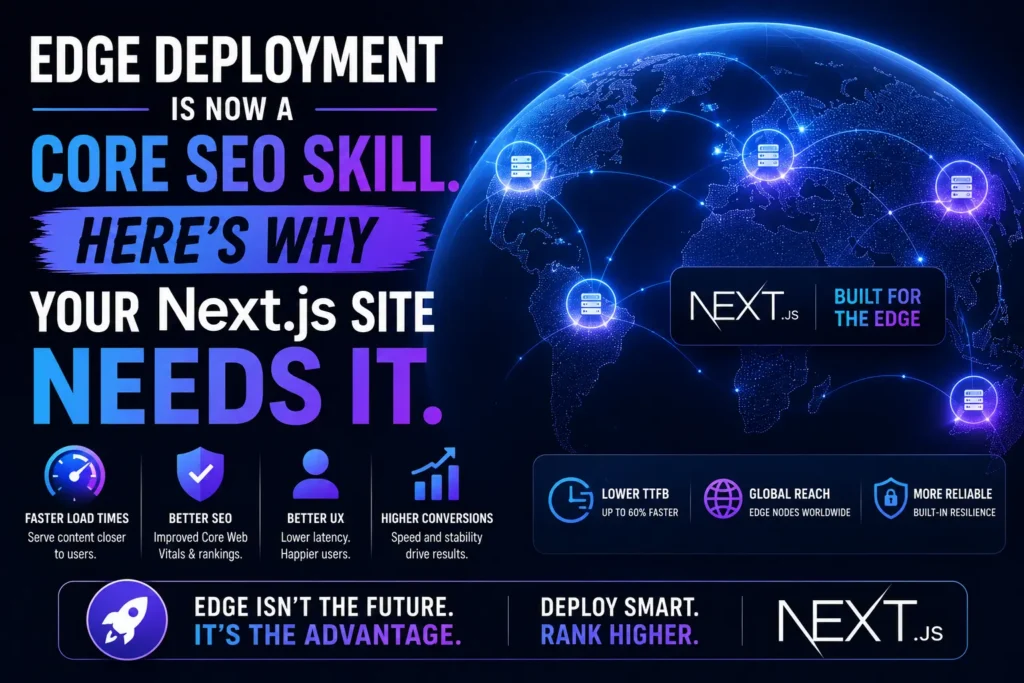

Edge deployment SEO performance is no longer a topic reserved for enterprise infrastructure teams and senior platform engineers. In 2026, it is the single most impactful technical lever available to Next.js site owners who want to improve their Core Web Vitals, close the performance gap on competitors, and stop leaving ranking potential on the table due to server latency that was never necessary.
In this article15 sections
The numbers make the case directly. Traditional server-side rendering from a centralised origin server produces TTFB (Time to First Byte) in the range of 200–800ms for global audiences. Edge-side rendering – where your application logic runs on servers distributed across 200+ global locations – reduces that figure to 20–50ms. That is not a marginal refinement. It is a 60–80% reduction in the latency your users experience, and it directly affects the Core Web Vitals scores that Google uses as ranking signals.
At Search Savvy, we consistently see technical SEO conversations stall at the keyword and content layer while a straightforward infrastructure decision – deploying to the edge – goes unmade. This post explains what edge deployment actually means for a Next.js site, why it has become a core SEO skill in 2026, and what you need to implement to capture those performance benefits.
What Is Edge Deployment and How Does It Affect SEO Performance?#
Edge deployment SEO performance is grounded in a fundamental principle of how the internet delivers content. In a traditional setup, your Next.js application runs on servers in one or two data centres – typically in a single region. When a user in Mumbai, Bengaluru, or Chennai requests your site that is hosted in a US East data centre, the request travels across the Atlantic, gets processed, and the response travels back. That round trip produces the latency you see as a high TTFB.
Edge deployment changes this architecture completely. Instead of a single origin, your application code runs on servers distributed across a global edge network – typically 200+ locations in the case of Cloudflare Workers and 126+ Points of Presence in the case of Vercel’s edge network. When a user in Bengaluru requests your site, they are served by an edge node in India – not one in Virginia. The round trip collapses from 300–400ms to 30–50ms.
That performance delta is not abstract. Google measures it as TTFB – and TTFB under 200ms is the gold standard in 2026 for achieving strong LCP (Largest Contentful Paint) scores. Edge computing deployment – specifically through services like Cloudflare Workers, Vercel Edge Functions, or AWS Lambda@Edge – is the most reliable technical path to achieving that threshold.
The SEO implications flow directly from the performance improvement:
- Better LCP scores → higher Page Experience signal → ranking advantage over competitors with slower sites
- Lower TTFB → faster initial render → lower bounce rates → better engagement signals
- Organic traffic increases of 12–20% are common after comprehensive Core Web Vitals optimisation that includes edge deployment
- 53% of mobile users abandon sites that take longer than 3 seconds to load – edge deployment eliminates this risk for global audiences
Why Is Edge Deployment SEO Performance Specifically Important for Next.js in 2026?#
Edge deployment SEO performance and Next.js have a uniquely tight relationship in 2026 – and understanding why requires a brief look at what Next.js has become as a framework.
In 2026, the question for Next.js is no longer “SSR or SSG?” – it is about choosing the right rendering strategy for each route, each component, and each section of a page. The rendering spectrum now available in Next.js looks like this:
| Strategy | When to Use | TTFB |
| Static Site Generation (SSG) | Content that never changes | Fastest – pre-built HTML from CDN |
| Incremental Static Regeneration (ISR) | Content that changes infrequently | Fast – cached, periodically rebuilt |
| Server-Side Rendering (SSR) | Real-time data required | Variable – depends on origin location |
| Streaming SSR | Progressive content delivery | Good – first byte fast, content loads progressively |
| Edge Runtime | Dynamic personalisation with global speed | 20–50ms TTFB globally |
The game-changer in Next.js’s 2026 architecture is Partial Prerendering (PPR) – an experimental feature that lets you combine static and dynamic content within a single route. The static shell renders instantly from a CDN, while dynamic content streams in from the edge. This means a product page can serve its static layout at CDN speed while personalised pricing, recommendations, or inventory availability load from the edge in milliseconds.
For SEO, the implication is significant: Google’s crawler evaluates your page experience based on real user metrics. A Next.js site that uses SSG or ISR for its public pages but falls back to origin-based SSR for dynamic content will have inconsistent Core Web Vitals across its page types – and inconsistency in CWV scores hurts ranking potential on the pages that matter most.
How Does the Next.js Edge Runtime Work for SEO in 2026?#
Edge deployment SEO performance in Next.js operates through the Edge Runtime – a lightweight JavaScript execution environment that runs on edge nodes rather than full Node.js servers. Enabling it for a route in Next.js is a single line of code:
export const runtime = ‘edge’;
That line changes where your route’s code executes – from your origin server to the nearest edge node to each requesting user. For a Next.js site deployed on Vercel, this means 0ms cold starts via the Edge Runtime and TTFB results like the 45ms measured in US East benchmarks for Q1 2026.
What can run at the Edge Runtime in 2026:
- Middleware (middleware.ts) – request interception, authentication checks, A/B testing splits, geo-based redirects, and header manipulation – all executing before your application code, at the network edge, with near-zero latency impact
- API Routes – dynamic data endpoints that need global speed without the overhead of a full origin server round trip
- Server Components – React Server Components can render at the edge, serving pre-composed HTML to users globally
- Personalisation logic – using the geolocation() function from Vercel, edge routes can serve region-specific content, currency formatting, or language variants without a full server round trip
Edge Runtime constraints to plan for: The Edge Runtime runs V8 isolates – not full Node.js. This means:
- No Node.js-specific APIs (fs, path, child_process)
- Limited memory and execution time per request
- Restricted access to native modules
In 2026, the Edge-compatible ecosystem has matured enough that most modern databases (PlanetScale, Neon, Turso), auth libraries (Auth.js), and utility packages work at the edge out of the box. The constraint primarily affects legacy Node.js packages – another reason to audit your dependency list before enabling edge runtime on existing routes.
What Core Web Vitals Does Edge Deployment Directly Improve?#
Edge deployment SEO performance maps onto Core Web Vitals in specific, measurable ways. Understanding the connection helps you prioritise which routes to migrate to edge first.
LCP (Largest Contentful Paint) – Target: Under 2.5 Seconds#
LCP measures how quickly the largest visible content element in the viewport renders. It is the Core Web Vital most directly affected by TTFB, because the browser cannot render content it has not received. Edge deployment attacks LCP at its root by reducing the time between request and first byte.
Without edge deployment: A hero image on a Next.js page served from a US origin server to a user in India starts loading at ~300ms TTFB. Factor in image transfer time, rendering, and any JavaScript parsing – and LCP easily exceeds 2.5 seconds on mobile.
With edge deployment: That same page served from an Indian edge node starts at ~30ms TTFB. LCP passes the 2.5-second threshold even on mobile connections with moderate bandwidth.
The LCP threshold must be met for at least 75% of page visits to pass Google’s evaluation. Edge deployment – combined with image optimisation (Next.js’s built-in next/image component converts and serves WebP at the edge automatically) – is the most reliable path to hitting that 75% threshold for global audiences.
INP (Interaction to Next Paint) – Target: Under 200ms#
INP replaced FID as a Core Web Vital in 2024 and is now the primary interactivity metric in 2026. It measures how quickly a page responds to all user interactions – not just the first click. While INP is more affected by JavaScript execution than server latency, edge-delivered pages have smaller JavaScript payloads because more work happens server-side (in Server Components) rather than being shipped to the client.
React Server Components, which execute on the server (or at the edge), do not contribute to client-side JavaScript bundle size. Moving logic from client components to Server Components – enabled by Next.js’s App Router – directly reduces the JavaScript that the browser must parse and execute, improving INP.
CLS (Cumulative Layout Shift) – Target: Under 0.1#
CLS measures visual stability – how much the layout shifts as a page loads. While CLS is less directly affected by deployment architecture than LCP, edge deployment indirectly improves it through faster, more consistent asset delivery. Pages that load faster have less opportunity for layout-shifting content (images loading late, fonts causing FOUT, or dynamic content pushing the layout around) because the full page render completes more quickly and more consistently across users.
Which Edge Deployment Platform Is Best for Next.js SEO in 2026?#
Edge deployment SEO performance outcomes vary between platforms – not dramatically, but enough to matter for globally-distributed traffic. At Search Savvy, the platform recommendation depends on the site’s specific architecture and geography needs:
Vercel (Native Next.js Platform)#
Vercel is the natural home for Next.js edge deployment – built by the same team that created the framework, with native support for every Next.js feature including Middleware, ISR with on-demand revalidation, PPR, and Server Actions.
Key 2026 benchmarks:
- 126 Points of Presence across 51 countries
- 45ms TTFB for US East server-rendered pages (Q1 2026)
- 0ms cold starts via Edge Runtime
- 14% faster than Netlify in global TTFB benchmarks (Q1 2026)
- Native next/image optimisation with zero configuration
- Automatic HTTPS, ISR, and preview deployments for pre-launch testing
Vercel’s limitation: its tight Next.js integration can introduce platform lock-in. Features like Edge Middleware, ISR with on-demand revalidation, and Server Actions are designed specifically for Vercel’s infrastructure.
Best for: Next.js teams deploying globally, wanting maximum framework compatibility and minimal configuration overhead.
Cloudflare Workers / Pages#
Cloudflare offers the broadest edge coverage – 330+ locations worldwide – and the industry’s fastest cold starts at under 5ms using V8 isolates. For sites targeting South Asian or other emerging-market audiences specifically, Cloudflare’s edge density in those regions is frequently superior to Vercel’s.
Key 2026 benchmarks:
- 330+ global edge locations
- Sub-5ms cold starts
- Handles millions of requests with consistent performance
- Supports Next.js via the @cloudflare/next-on-pages adapter (some cutting-edge Next.js features require compatibility checking)
Best for: Teams with specific emerging-market geographic requirements, or those already using Cloudflare’s CDN and DDoS protection infrastructure.
The SEO Verdict#
For a Next.js site being built or migrated for SEO performance in 2026, Vercel is the default recommendation for teams who want zero-configuration access to every Next.js edge feature. Cloudflare Pages is the right choice when global edge density and cold start performance are the primary priorities – particularly for Indian and South-East Asian audiences.
How Does Edge Deployment Interact with Googlebot Crawling?#
Edge deployment SEO performance benefits extend to crawling, not just user experience. One of the most frequently overlooked advantages of edge deployment for Next.js sites is how it handles Googlebot’s interaction with JavaScript-rendered content.
Googlebot renders JavaScript – but not as fast as it reads server-rendered HTML. A Next.js page that depends on client-side rendering for its primary content may be crawled and indexed with a significant delay, because Googlebot first indexes the raw HTML and queues JavaScript rendering as a secondary step.
Edge deployment solves this because Server Components and edge-rendered pages deliver complete HTML to Googlebot on the first request – no JavaScript rendering required. The crawler receives fully-formed, indexable content immediately. This is particularly important for:
- Dynamic product pages where pricing or inventory might otherwise require client-side fetching
- Personalised content served via geo-targeting at the edge
- Blog or article pages with dynamic related content sections
- Any route that currently uses useEffect or client-side data fetching for content that should be indexed
Redirects managed at the edge via Next.js middleware or vercel.json also execute before the application boots – meaning Googlebot encounters the correct final URL faster and with less redirect chain overhead.
What Is the Edge Deployment SEO Implementation Priority List for 2026?#
At Search Savvy, the edge deployment implementation sequence we recommend for Next.js sites is ordered by SEO impact versus implementation complexity:
Immediate wins (low complexity, high impact):
- Deploy to Vercel or Cloudflare Pages if currently on shared hosting or a single-region VPS – this single change reduces TTFB significantly for global users without any code changes
- Enable next/image for all images – automatic WebP conversion and edge-delivered responsive images with zero custom code
- Implement next/font with display: swap – eliminates FOUT (Flash of Unstyled Text) that causes CLS
- Configure Cache-Control headers for static assets – s-maxage=31536000, stale-while-revalidate for immutable assets
Medium-term optimisations (moderate complexity, sustained impact):
- Migrate API routes serving user-facing content to Edge Runtime (export const runtime = ‘edge’)
- Implement ISR for content pages that update periodically (blog posts, product pages) – fresh content without origin server load
- Move authentication and A/B testing logic to Next.js Middleware (middleware.ts) so it executes at the edge
- Audit client components and move data-fetching logic to Server Components where possible – reduces client JS bundle and improves INP
Advanced implementations (higher complexity, targeted gains):
- Implement Partial Prerendering (PPR) for routes that mix static and dynamic content
- Configure geo-based personalisation at the edge using Vercel’s geolocation() or Cloudflare’s geo headers
- Set up multi-layer caching: browser → CDN → edge → origin, with intelligent cache invalidation on content updates
- Implement ISR on-demand revalidation – pages stay fresh without rebuild cycles, critical for time-sensitive content
FAQ: Edge Deployment SEO Performance for Next.js in 2026#
Q1: Does edge deployment directly improve Google rankings? Yes – indirectly but measurably. Edge deployment improves TTFB (Time to First Byte), which is the primary driver of LCP (Largest Contentful Paint). LCP is a confirmed Google ranking signal through the Page Experience framework and Core Web Vitals. Sites that achieve LCP under 2.5 seconds for 75% of page visits have a ranking advantage over equivalent pages with slower performance. Organic traffic increases of 12–20% are common after comprehensive Core Web Vitals optimisation that includes edge deployment.
Q2: What is the difference between Next.js Edge Runtime and standard Node.js runtime? The Edge Runtime executes JavaScript in V8 isolates on distributed edge nodes – typically 200+ global locations. Standard Node.js runtime executes on a full server, typically in one or two centralised regions. The Edge Runtime offers dramatically lower latency (20–50ms TTFB vs 200–800ms) but operates under constraints: no Node.js-specific APIs, limited memory, and restricted native module access. In 2026, most modern databases and utility packages support the Edge Runtime, making it viable for the majority of application logic that doesn’t depend on legacy Node.js packages.
Q3: What TTFB should a well-optimised Next.js site achieve in 2026? The gold standard for TTFB in 2026 is under 200ms – and ideally under 50ms for users served from nearby edge nodes. Vercel’s edge-deployed Next.js applications achieve around 45ms TTFB for US East regions. Edge-side rendering globally targets 20–50ms compared to 200–800ms for origin-server rendering. TTFB under 200ms is typically sufficient to achieve strong LCP scores when combined with image optimisation and minimal render-blocking resources.
Q4: Is Vercel the only option for Next.js edge deployment? No. While Vercel offers native Next.js support with zero-configuration edge deployment, Cloudflare Pages with the @cloudflare/next-on-pages adapter provides 330+ edge locations and sub-5ms cold starts – making it superior for emerging-market geographic reach. Netlify also supports Next.js via Runtime v5, though cutting-edge features like Middleware and ISR revalidation may have compatibility gaps. AWS Lambda@Edge and Fastly Compute@Edge are available for enterprise teams with existing AWS or Fastly infrastructure.
Q5: Does Core Web Vitals performance affect AI Overview citation eligibility? Yes – indirectly but significantly. Google’s Page Experience signals, including Core Web Vitals, contribute to the overall page quality assessment that determines AI Overview citation eligibility. A page with poor Core Web Vitals scores is evaluated as providing a poor user experience – which lowers its overall quality score. Given that 96% of AI Overview citations come from sources with verified E-E-A-T signals, and that page performance is part of the trust evaluation, edge-optimised performance is a prerequisite for competitive AI citation rates.
Q6: How does Partial Prerendering (PPR) improve SEO in Next.js 2026? Partial Prerendering allows a Next.js route to serve a static HTML shell instantly from a CDN edge, while streaming dynamic content from the edge server in the same request. For SEO, this means: the static shell is available to Googlebot immediately (fast crawling), the dynamic content renders progressively without blocking the initial HTML (better LCP), and the page’s overall performance profile combines CDN speed with dynamic flexibility. PPR is experimental in Next.js 15 but is actively being adopted by high-traffic production sites in 2026.
The Bottom Line#
Edge deployment SEO performance is the layer where technical architecture and search ranking strategy converge most directly in 2026. A Next.js site with excellent content, clean schema markup, and strong E-E-A-T signals – but served from a single-region origin with 400ms TTFB for users in India, Southeast Asia, or the Middle East – is giving up ranking potential to every competitor whose infrastructure runs closer to those users.
The infrastructure decision is straightforward. Deploying to Vercel or Cloudflare Pages, enabling the Edge Runtime on dynamic routes, implementing ISR for periodically-updated content, and moving authentication and geo-logic into Middleware – these are the actions that close the performance gap. They are no longer advanced engineering concerns. They are core SEO decisions.
At Search Savvy, technical SEO in 2026 means understanding the full stack from schema markup to edge deployment – because Google evaluates the full experience, and so do users. If your Next.js site’s Core Web Vitals are underperforming and infrastructure latency is the cause, get in touch with the Search Savvy team. We’ll tell you exactly where the performance is leaking and what it would take to fix it.