

Long-Tail Keywords are the single most underestimated opportunity in SEO – and in 2026, they’ve become the foundation of every content strategy that actually generates revenue. Consider the numbers: long-tail keywords account for 91.8% of all Google searches, deliver 2.5x higher conversion rates than short-tail terms, and in an era where Google’s AI Overviews frequently absorb traffic from broad, head-term queries, long-tail keywords remain one of the few reliable pathways to organic clicks that convert. At Search Savvy, we consistently see businesses investing their entire content budget chasing one-word or two-word “head terms” they have no realistic chance of ranking for – while ignoring hundreds of specific, high-intent queries their target customers are typing every single day. This guide changes that. We’ll explain exactly what long-tail keywords are, why they matter more than ever in 2026, and a step-by-step process for finding the ones that will actually move your business forward.
What Are Long-Tail Keywords?
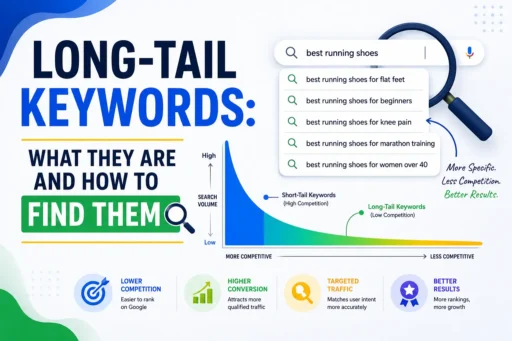
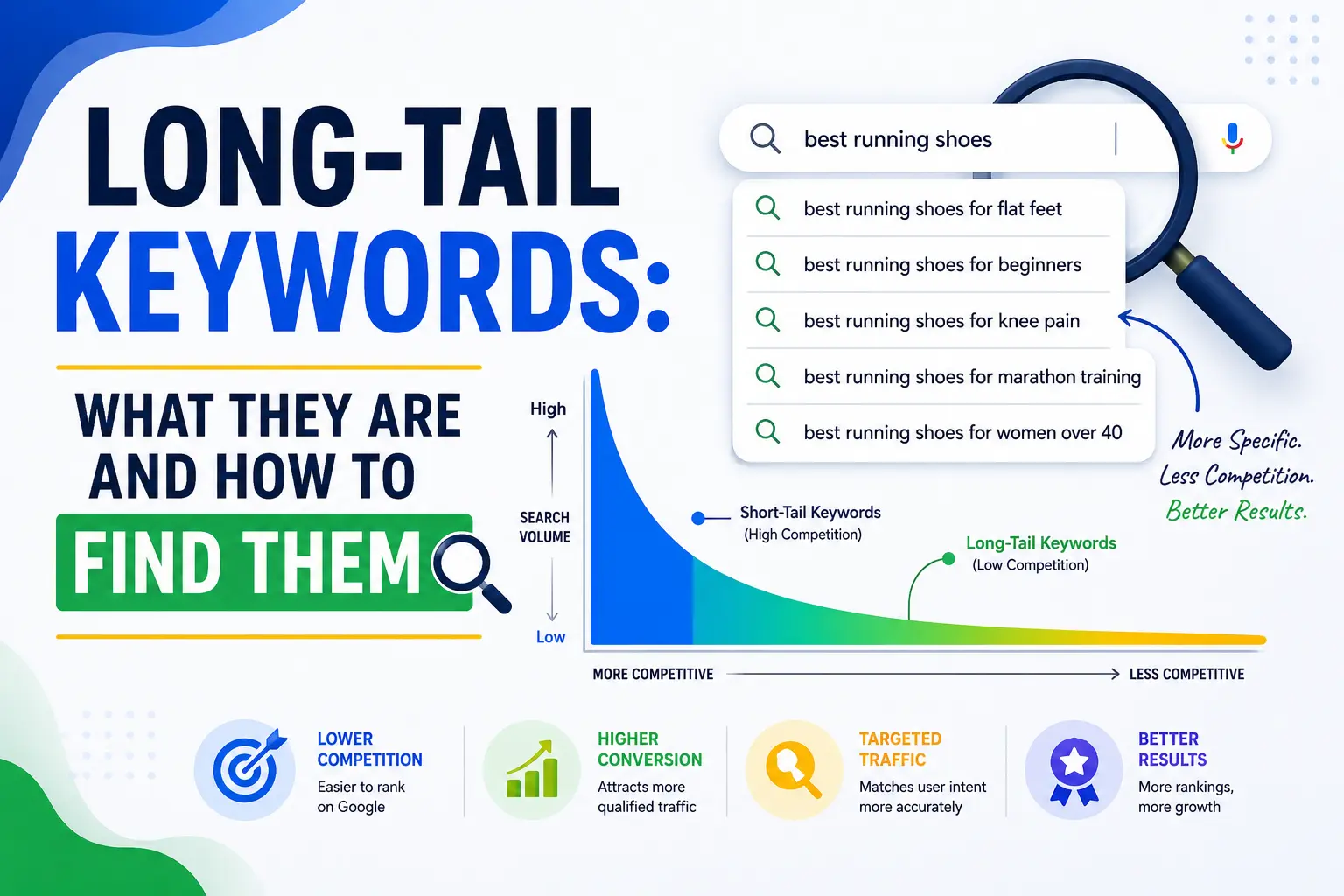
Long-Tail Keywords are highly specific search phrases, typically three or more words in length, that reflect clear user intent. They’re called “long-tail” not because they’re grammatically long, but because they occupy the tail end of the search demand curve – each individual phrase has low search volume, but collectively they represent the vast majority of all searches ever made.
The distinction between short-tail and long-tail is best understood through examples:
| Short-Tail (Head Term) | Long-Tail Keyword |
| “shoes” | “best running shoes for women with flat feet” |
| “SEO” | “how to do keyword research for a new website in 2026” |
| “restaurant” | “best vegetarian restaurant in Bandra Mumbai for dinner” |
| “marketing agency” | “affordable digital marketing agency for small business in Pune” |
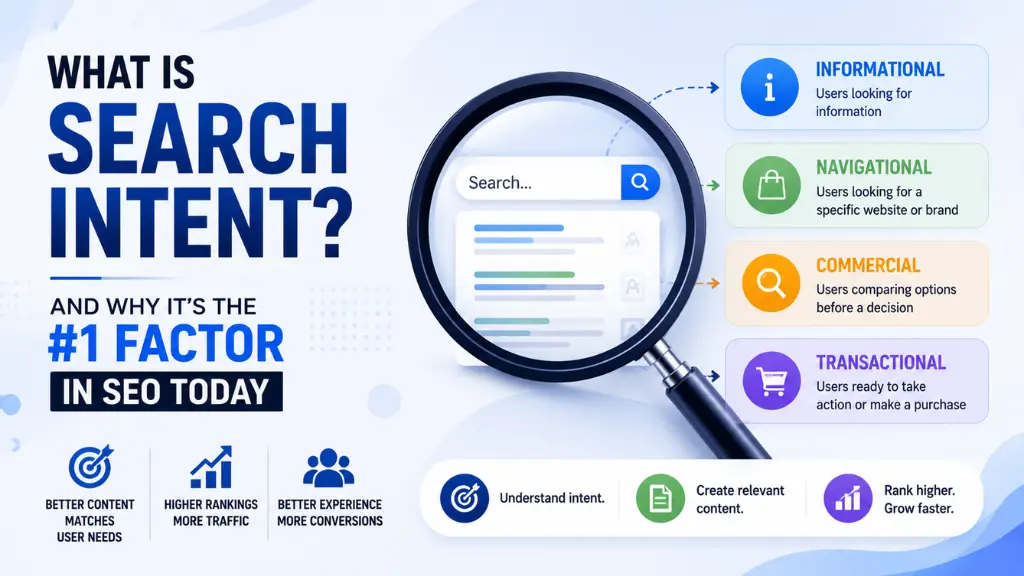
The person searching “shoes” is browsing. The person searching “best running shoes for women with flat feet” is ready to buy. That difference in intent is what makes long-tail keywords so valuable – not in spite of their specificity, but because of it.
An important clarification: Long-tail keywords are named for the search volume distribution, not word count. A three-word phrase can still be a highly competitive head term if it’s vague (“best SEO tips”). A five-word phrase can be a perfectly targeted long-tail if it’s specific. Focus on specificity, not just length.
Why Are Long-Tail Keywords So Important in 2026?
Long-Tail Keywords have become more important in 2026 than at any previous point in SEO – and the reason is a structural shift in the search landscape:
Google’s AI Overviews are absorbing head-term traffic. In 2026, Google’s AI Overviews increasingly answer broad, short-tail queries directly on the search results page – reducing the organic clicks those queries used to deliver to websites. But when users search for specific, long-tail queries, AI often can’t provide a complete, highly specific answer. That’s where optimised pages still win clicks. Long-tail content that directly answers complex questions is the fuel AI engines run on – and it simultaneously earns traditional rankings and AI Overview citations.
The competitive reality of head terms. “SEO tips,” “digital marketing,” “web design” – these are owned by billion-dollar domains with thousands of backlinks and years of domain authority. If you’re not a major industry player, competing for short-tail keywords may simply be a waste of time. Long-tail keywords narrow the playing field drastically. You’re not trying to outrank every site on the internet – you’re trying to be the best answer for a very particular question.
The conversion data is compelling. Long-tail keywords deliver around 2.5× higher conversion rates compared to short-tail terms, and 56% of buyers use queries of 3+ words, with only 7% using one-word searches. The visitor who finds your page through a long-tail search has already qualified themselves – they know what they need, and they’re significantly closer to a decision.
Voice and AI search are inherently long-tail. Voice search is inherently long-tail. As more consumers use tools like Google Lens or ask questions to LLMs, the importance of natural, question-based keywords will only increase. Optimising for these phrases is now also a core component of GEO (Generative Engine Optimisation) – because AI engines are designed to provide the best single answer, not just a list of links. Long-tail content that directly answers a complex question is exactly what they prioritise.
What Are the Different Types of Long-Tail Keywords?
Long-Tail Keywords are not all the same – and understanding the distinction is critical for how you target and create content around them.
Type 1: Topical Long-Tail Keywords
Topical long-tail keywords are phrases that get low search volume simply because they cover a very specific topic. Nobody searches for them in large numbers because the audience is naturally small. For example, “project management software for marine engineers” might get 30 searches a month, but every one of those visitors has an exact, defined need.
These keywords tend to have genuinely low competition because few pages bother to target such a narrow topic. The 30 monthly visitors they generate will be infinitely more valuable than 3,000 vague visitors from a broad term.
Type 2: Supporting Long-Tail Keywords
Supporting long-tail keywords are variations of a broader, competitive head term. Think “best free SEO tool for small business.” This keyphrase looks long-tail by word count, but the competition is fierce because dozens of high-authority pages already target the parent topic of “best SEO tool” and naturally rank for all its variations too.
For supporting long-tail keywords, you need to assess the actual keyword difficulty – not assume low competition just because the phrase is longer. Check the competitive landscape before committing content resources.
Type 3: Conversational / Question-Based Long-Tail Keywords
These are natural-language queries that mirror how people speak to voice assistants and type into AI search engines: “what’s the best time to post on Instagram for a business account?” or “how long does it take to see results from SEO?”
Question-based keywords are particularly valuable in 2026 because they map directly to People Also Ask boxes, featured snippets, and AI Overview citations. Building FAQ sections and question-headed H2/H3 subheadings around these queries is the most reliable content format for capturing this traffic type.
How Do You Find Long-Tail Keywords? (8 Proven Methods)
Long-Tail Keywords are waiting to be discovered – and the best sources are often free.
Method 1: Google Autocomplete
Long-Tail Keywords surface naturally in Google’s search bar. Start typing your seed keyword and observe the autocomplete suggestions – these are the exact phrases real people are searching for, in their own words, in real time. Also scroll to the bottom of any results page for “Related Searches” – another gold mine of specific, long-tail variations.
Process: Type your core topic, note every autocomplete suggestion, then repeat with “who,” “what,” “when,” “where,” “why,” and “how” prefixes to surface question-based long-tail variations.
Method 2: People Also Ask (PAA) Boxes
Long-Tail Keywords are literally handed to you by Google’s People Also Ask feature. Every PAA question is a confirmed user query that Google has validated as relevant to your topic. Click through each PAA question – the box expands and generates additional related questions, creating a cascading web of long-tail keyword opportunities.
Pro tip: PAA questions that begin with “what,” “how,” “why,” and “is” are particularly valuable for question-based content – and they directly match the query formats that AI Overview answers prioritise for citation.
Method 3: Google Search Console
Long-Tail Keywords your site is already ranking for are hidden in plain sight in your Google Search Console Performance report. Filter your queries by impressions (over 50) but clicks near zero – these are long-tail queries where you’re appearing but not earning the click, representing quick-win optimisation opportunities without any new content creation.
This is one of the most reliable long-tail keyword sources because it’s real user data – not keyword tool estimates.
Method 4: Ahrefs Keywords Explorer
Long-Tail Keywords can be discovered at scale using Ahrefs Keywords Explorer. Enter your seed keyword, then filter by:
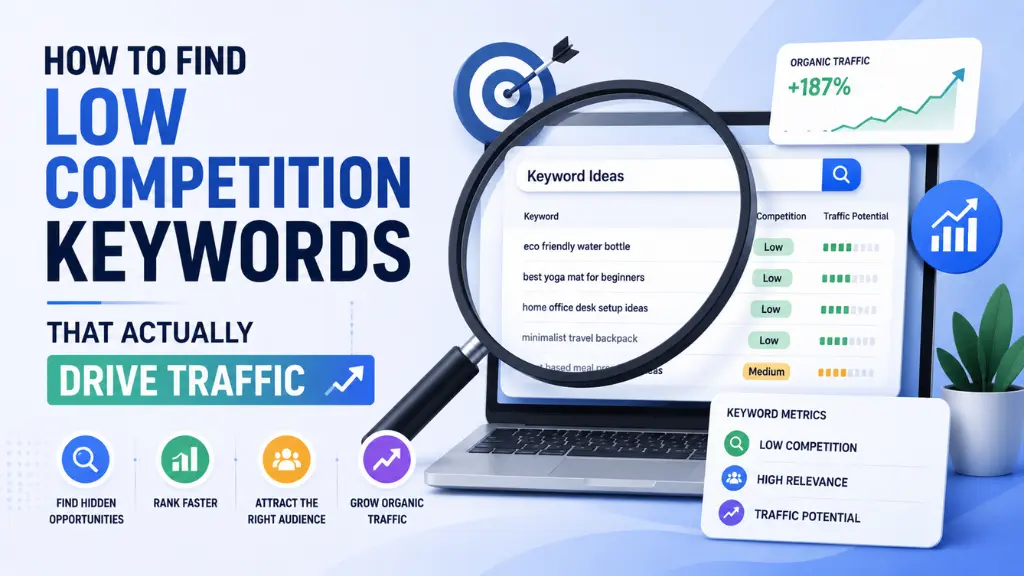
- Keyword Difficulty (KD) under 30 – the target zone for most sites below Domain Rating 50
- Questions filter – surfaces only question-based queries
- Monthly Search Volume: 10–500 – the typical long-tail volume range where competition is low but intent is high
Export the results, sort by business relevance, and you have a ready-to-execute long-tail content roadmap.
Method 5: Semrush Keyword Magic Tool
Long-Tail Keywords can also be discovered using Semrush’s Keyword Magic Tool. Enter your core term, use the “Questions” filter to surface query-based long-tails, and apply a KD filter under 30 to isolate low-competition opportunities. Semrush’s topic clustering feature automatically groups related long-tail keywords – invaluable for planning content clusters that target multiple long-tail phrases with a single page.
Method 6: Reddit, Quora, and Community Platforms
Long-Tail Keywords live in the exact language your audience uses – and there’s no better source for that language than the communities where they ask each other questions.
Look for threads in your niche on Reddit and Quora. Titles like “Is a 4070 Ti good for 4k gaming?” are perfect long-tail topics. These are unfiltered, real-world questions in natural language – exactly the format AI search engines are optimised to answer and exactly what your long-tail content should target.
The additional benefit: content that mirrors the language of Reddit threads and Quora questions tends to rank for the same phrasing – because those platforms and your content are answering the same underlying query.
Method 7: YouTube Autocomplete
Long-Tail Keywords on YouTube often differ from those on Google – and since YouTube is the world’s second-largest search engine, this represents a distinct discovery channel. Type your core topic into YouTube’s search bar and collect autocomplete suggestions. These tend to be longer, more instructional, and more conversational than Google’s – reflecting the “how-to” intent dominant on video platforms. If the keyword works as a video concept, it typically works as a blog post concept too.
Method 8: Customer Language – Reviews, Sales Calls, and Support Tickets
Long-Tail Keywords that convert best often come directly from your existing customers.
When a customer writes a review, they aren’t trying to do SEO. They are trying to be helpful. They use natural, descriptive language. Phrases like “a t-shirt that doesn’t shrink in the wash” or “accounting software that doesn’t require any training” are high-value long-tail keywords sourced directly from buyers who’ve already made a purchase decision.
Review your customer reviews, record your sales call language, and mine your support tickets. The specific phrases your customers use to describe their problems are the exact queries your future customers are typing into Google.
How Do You Use Long-Tail Keywords in Your Content?
Long-Tail Keywords work best when correctly mapped to content – and the approach in 2026 has shifted significantly from the old “one keyword per page” model.
Cluster Multiple Long-Tails Into One Page
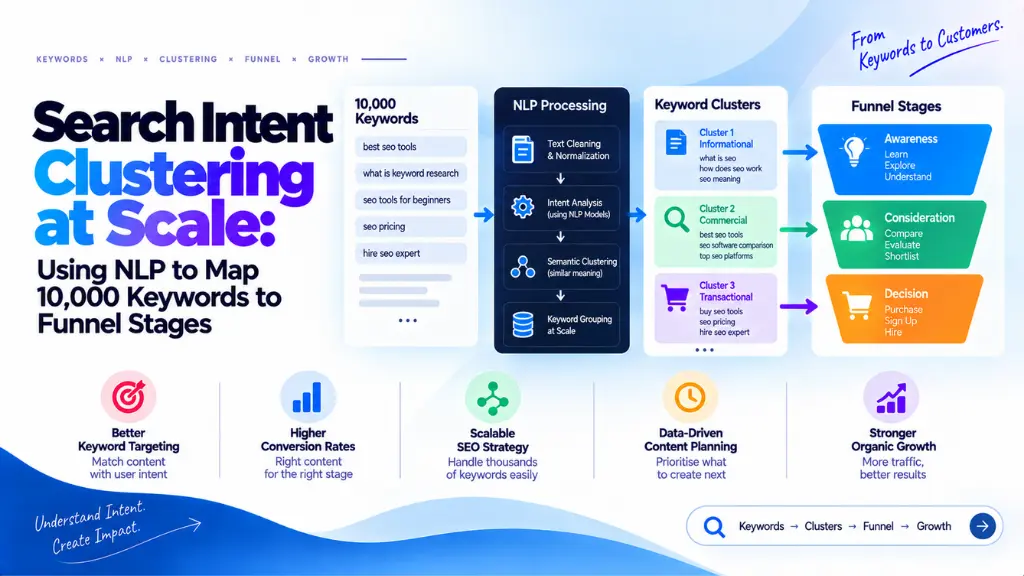
Never create one page per keyword. Cluster semantically related long-tail terms into a single page. All targeting the same intent, the same page, and the same reader – one comprehensive page covering this cluster outranks five thin individual pages every time.
Example cluster for a single page:
- “how to do keyword research for a new website”
- “keyword research for beginners step by step”
- “best way to find keywords for a new website”
- “how to choose keywords for a new blog”
All four terms have the same intent (keyword research guidance for beginners) and belong on the same page. Targeting them individually creates thin, cannibalising content. Combining them into one comprehensive guide captures all four.
Placement Checklist for Long-Tail Keywords
Once you’ve identified your target long-tail cluster, place the primary phrase in these locations:
- Title tag – in the first 60 characters
- H1 heading – the primary keyword in your page heading
- First 100 words – establish the topic early for AI extraction
- At least 2–3 H2 headings – particularly effective when phrased as questions
- Meta description – naturally embedded in the value promise
- URL slug – short, hyphenated, keyword-inclusive
- Image alt text – where descriptively appropriate
At Search Savvy, we recommend treating long-tail keyword content like precision tools rather than volume plays. Each long-tail cluster page should be the most complete, specific, and experience-backed resource available for that exact query. That specificity is what earns clicks from motivated buyers – and citations from AI search engines simultaneously.
People Also Ask: Long-Tail Keyword Questions
Q: Are long-tail keywords worth targeting if they have very low search volume?
Yes – absolutely. Zero-volume keywords are not zero-opportunity. They often reflect emerging queries Google has not yet indexed in keyword tools, or ultra-specific queries where every single visitor has high purchase intent. Fifty targeted, high-intent visitors from a long-tail query will consistently outperform 5,000 vague visitors from a broad head term in terms of leads, conversions, and revenue.
Q: How many long-tail keywords should I target on one page?
A single page can effectively target 3–8 semantically related long-tail keywords when they share the same underlying search intent. The key constraint is intent alignment, not keyword count. If two long-tail phrases require different types of content to fully answer (e.g., one is informational and one is transactional), they need separate pages. If they can all be answered by the same article, combine them.
Q: Do long-tail keywords work for local SEO?
Yes – and they’re particularly powerful for local search. Long-tail keywords naturally incorporate location modifiers (“best accountant for small business in Hyderabad”), service qualifiers (“affordable roof repair Mumbai”), and intent signals (“dentist near me open Sunday”) that are the backbone of local SEO success. For local businesses, the majority of high-converting queries are inherently long-tail.
Frequently Asked Questions (FAQ)
Q1: What is the difference between long-tail and short-tail keywords? Short-tail (head) keywords are broad, 1–2 word queries with high search volume and high competition (e.g., “SEO”). Long-tail keywords are specific, 3+ word phrases with lower volume but higher intent and lower competition (e.g., “how to do SEO for a new business website in 2026”). The key difference is user intent – short-tail searchers are browsing; long-tail searchers are usually ready to act.
Q2: What keyword difficulty should I target for long-tail keywords? For most sites with a Domain Rating under 50, target long-tail keywords with a Keyword Difficulty (KD) score under 30 in Ahrefs or a Difficulty score under 40 in Semrush. Sites with strong existing authority can compete for KD 30–50 long-tails. Avoid spending resources on long-tail keywords above KD 60 – regardless of how specific they appear, the SERP competition for those terms is already intense.
Q3: How long does it take to rank for long-tail keywords? For new websites targeting genuinely low-competition long-tail keywords (KD under 20), first-page rankings can appear within 4–8 weeks of publishing well-optimised content. For established sites, ranking movement is often visible within 2–4 weeks. Long-tail keywords are one of the fastest-ranking content opportunities available – particularly for sites that lead with direct answers and include FAQ schema markup.
Q4: Should I include long-tail keywords in my meta title and description? Yes – particularly when the long-tail phrase closely matches the search query. Including the specific long-tail keyword phrase in your title tag improves both ranking relevance and CTR, because the user’s exact search term appears in bold in the SERP. For meta descriptions, include the phrase naturally as part of the value promise – this reinforces relevance and improves click-through rate from users who see their exact query reflected in the snippet.
Q5: Do long-tail keywords help with AI Overview and ChatGPT visibility? Yes – significantly. According to Search Savvy’s AI visibility analysis, long-tail keywords are the content format most frequently cited in AI-generated answers for several reasons: they represent specific questions that AI engines can cleanly answer, they have clear intent that maps to direct answers, and their FAQ-style structure is the format AI Overview extracts from most reliably. Optimising long-tail content with direct answers in the first 100 words, question-based H2/H3 headings, and FAQPage schema creates content that simultaneously ranks in Google and gets cited in AI-generated responses.
Q6: What free tools can I use to find long-tail keywords? The best free tools for long-tail keyword research in 2026 include: Google Autocomplete and Related Searches (no account needed), People Also Ask boxes (in every search result), Google Search Console (for discovering queries you already rank for), Google Keyword Planner (free with a Google Ads account), Ubersuggest (limited free searches per day), and Reddit and Quora (for real-world search language). For paid research, Ahrefs and Semrush offer the most comprehensive long-tail keyword databases available.
Final Thoughts
Long-Tail Keywords are the most reliable path to organic traffic and AI search visibility for any business that isn’t already a dominant authority in its niche – which means they’re the right starting strategy for the vast majority of websites publishing content in 2026.
The math is straightforward: 91.8% of searches contain long-tail keywords. Google’s AI Overviews frequently capture head-term traffic. And long-tail content – specific, intent-aligned, experience-backed – delivers higher conversions, earns AI citations, and ranks faster than broad content targeting terms no new site has a realistic chance of winning.
The businesses that will dominate organic search through the rest of this decade are the ones building comprehensive long-tail content clusters around the specific questions their customers are asking – not the ones writing generic content for keywords their competitors have owned for a decade.
Search Savvy helps businesses identify, prioritise, and create long-tail keyword content that ranks in Google, earns citations in AI search engines, and drives the qualified traffic that actually converts into revenue.