
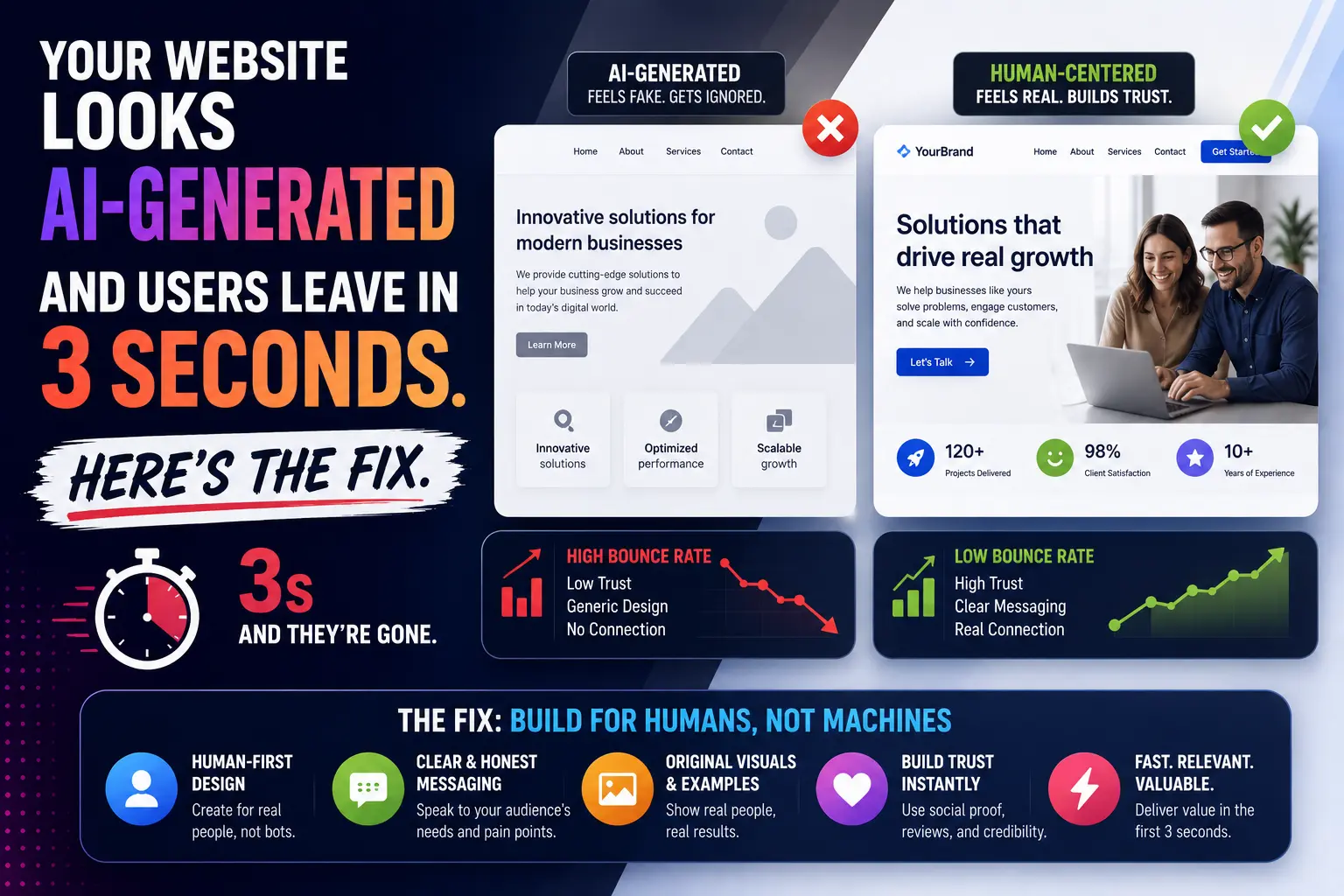

Human-centered web design is having its moment – and for a very specific reason. The internet in 2026 is saturated with websites that look identical: the same smooth AI-generated hero images, the same filler copy that says a lot while meaning nothing, the same hyper-polished aesthetic with zero personality. Users have seen it thousands of times. They recognise it instantly. And they leave.
This is not a design problem. It is a trust problem.
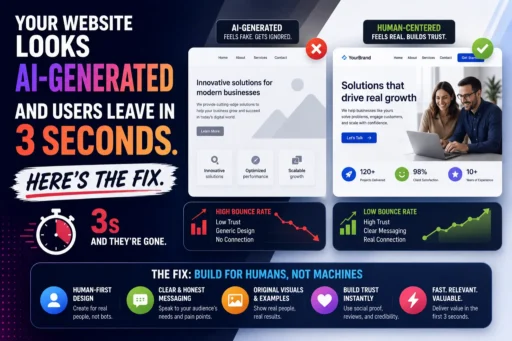
At Search Savvy, we consistently see it in client analytics: good traffic, reasonable rankings, and then a bounce rate that tells you people are clicking off within seconds of arriving. The content is there. The SEO is solid. But something about the experience signals automated, impersonal, and not worth staying for – and users obey that signal without a second thought.
The data backs this up. Web design influences 94% of potential customers’ first impressions of a page, and users form that opinion in just 50 milliseconds. Meanwhile, 46% of people trust a brand less when they discover it is using AI to provide experiences they assumed were coming from a human. And 88% of users say they won’t return after a bad website experience.
This post will show you exactly what makes a website look AI-generated, why it damages your business, and – most importantly – the specific human-centered web design principles that fix it.
What Does “AI-Generated” Actually Look Like to a Website Visitor?
Human-centered web design starts with recognising what its opposite looks like – and being honest about whether your own site has fallen into these patterns.
Users do not consciously think “this looks AI-generated.” But their instincts fire immediately. Designers call it the “AI Glaze” – a specific quality of over-polish, sameness, and absence of personality that high-performing AI image generators and content tools still consistently produce. It signals automation. It signals a lack of genuine effort. And it triggers subconscious distrust before a user has read a single word.
The specific signals that make a website feel AI-generated:
Visual signals:
- Stock-smooth hero images with perfect lighting, diverse but generic human figures, and a slight uncanny valley quality
- Layouts that follow the exact same template as hundreds of other sites in the same category
- No visual imperfection – no grain, no texture, no evidence of a human hand anywhere on the page
- Icon sets and illustration styles that are clearly from the same generative AI aesthetic
Content signals:
- Opening paragraphs that make grand claims without specific detail: “We help businesses achieve their goals through innovative solutions”
- Lists of services or features that could describe any company in the same industry
- No specific client names, real project outcomes, or genuine case studies
- Author names with no photo, no bio, and no verifiable existence
Experience signals:
- Forms that ask for everything but explain nothing about what happens next
- Navigation that mirrors every competitor’s structure without any personality
- Pages that load slowly despite containing almost no genuine original content
- Copy that reads like it was edited for keyword density, not for a human reader
As one 2026 branding analysis noted: if your website looks like it was generated by a prompt, customers subconsciously assume your service is automated too. That association is damaging and difficult to undo.
Why Does the AI-Generated Look Hurt Your Business in 2026?
Human-centered web design matters more in 2026 than at any previous point – because the context has fundamentally changed. When AI-generated content was rare, a polished, competent-looking site was a competitive advantage. Now that it is the default, polished and generic is indistinguishable from lazy and automated.
After years of AI-generated content flooding search results, 2026 marks a decisive pivot toward human connection in marketing that audiences can actually feel. The saturation point arrived faster than most predicted – users now scroll past generic, algorithm-optimised copy with the same indifference they show banner ads.
The business consequences are measurable:
- Poor design and generic content drive 38% of web visitors away immediately (Hostinger, 2026)
- Bounce rates increase 32% when pages load beyond 2.5 seconds – and AI-heavy pages often load slowly due to large image files (Google Core Web Vitals data, 2025)
- 61.5% of web designers believe poor navigation is the primary reason visitors leave a website
- 88% of users say they will not return after a bad website experience
- A page with 30% more white space sees 20% higher comprehension rates – the cluttered, widget-heavy templates AI builders default to are the opposite of this
And the SEO implications are just as significant. Google’s quality raters are specifically trained to evaluate Experience, Expertise, Authoritativeness, and Trustworthiness (E-E-A-T). A website that looks and reads as though no genuine human expertise created it will struggle to earn the trust signals that determine AI Overview citations and top-of-page rankings.
What Is Human-Centered Web Design and How Does It Work?
Human-centered web design is the practice of building websites around the real needs, behaviours, and emotional responses of specific human visitors – rather than around templates, trends, or AI-generated defaults. It is the deliberate choice to prioritise human craftsmanship and emotional resonance as a direct response to the sea of identical, AI-produced content.
It does not mean avoiding AI tools. It means ensuring that AI serves human decision-making rather than replacing it. While 78% of designers and developers say AI significantly improves their efficiency, only 32% say they can rely on its output – supporting the idea that AI can speed up web design workflows, but human judgement still matters for brand fit, usability, and quality control.
The Nielsen Norman Group’s State of UX 2026 report frames the challenge directly: trust in AI experiences is the new design problem, and human direction remains essential for shipping products that work.
Human-centered web design operates across four dimensions:
How Do You Make a Website Feel Genuinely Human?
1. Replace Generic Visuals With Evidence of Real People and Real Work
Human-centered web design starts with your imagery. Nothing signals “AI-generated” faster than a hero image of a diverse group of generic professionals in a glass-walled office that looks like it was created by a prompt.
What to use instead:
- Real photographs of your actual team – candid, not staged. Imperfection is trust.
- Behind-the-scenes images of your actual workspace, products, or process
- Client project documentation – screenshots of real results, before/after comparisons, actual deliverables
- Custom illustrations with visible texture and personality, rather than smooth, generated iconography
The biggest trend for 2026 is Human-Centric Design. As AI content becomes saturated, brands are pivoting back to hand-drawn illustrations, textured typography, and imperfect aesthetics to signal authenticity and build trust.
The principle: in a world where flawless, glossy AI imagery is the default, “perfection” is starting to look cheap. A slightly imperfect, genuinely human photograph of your real team communicates more trust than a technically superior AI-generated alternative.
2. Write Copy That Only You Could Have Written
Human-centered web design demands specificity in language. Generic claims – “We deliver results”, “Your success is our priority”, “We’re passionate about innovation” – are invisible. Users have read them ten thousand times. They process them as noise and move on.
Specific, human copy sounds like this:
- Named outcomes: “We reduced a Pune-based D2C brand’s cost-per-acquisition by 34% in 90 days” – not “We drive measurable ROI”
- Genuine voice: Write the way your best team member actually speaks to a client in a meeting – not the way a corporate communication template suggests
- Honest limitations: Stating what you don’t do, who you don’t work with, or where you have the most expertise builds more trust than presenting as an all-things-to-all-people solution
A typical website visitor reads only 28% of written content – but 70% of users read lists with bullet points versus 55% who read lists without them. Make your specific claims scannable.
3. Build Navigation and Structure Around Your User’s Mental Model
Human-centered web design means your information architecture reflects how your users think about their problem – not how your team thinks about your services.
Most AI-generated site templates use the same navigation structure: Home → About → Services → Blog → Contact. That structure is about the business, not the user. A human-centred alternative organises around user intent:
- What does my visitor need to accomplish in the next 30 seconds?
- What question are they trying to answer before they decide to trust us?
- What evidence do they need to see before contacting us?
Better navigation can reduce bounce by 10–15% and increase task success by up to 40%. Centred CTAs get up to 682% more clicks than misaligned buttons. These are not marginal improvements – they are the difference between a site that works and one that looks good but converts poorly.
4. Make Performance a Human Issue, Not Just a Technical One
Human-centered web design treats page speed as an empathy issue. Every additional second of load time is a second you are wasting a visitor’s time. And in 2026, users are less tolerant of this than ever.
The numbers are unambiguous:
- 47% of users expect pages to load in 2 seconds or less
- Bounce rates rise 32% when load time increases from one to three seconds
- Bounce rates rise 123% when load time increases from one to ten seconds
- 60% of users leave if a site takes over two seconds to load on mobile
AI-generated sites often have large, unoptimised image files, excessive third-party scripts, and bloated page builders – all of which drag load times. A site that looks beautiful but loads slowly communicates something very specific about how much you value a visitor’s time.
Actionable steps:
- Compress and serve images in WebP format
- Audit and remove unnecessary third-party scripts and tracking pixels
- Use a performance-focused hosting provider (Cloudways, Kinsta, or WP Engine for WordPress)
- Check your Core Web Vitals monthly via Google Search Console
5. Add Social Proof That Is Impossible to Fake
Human-centered web design leverages the one content type that AI cannot generate: authentic customer voices.
The brands winning in 2026 aren’t the ones with the biggest AI budgets. They’re the ones who understand the paradox – in the age of artificial everything, authenticity is the only currency that appreciates.
Generic testimonials – “Great service! Highly recommended. – J.S.” – carry almost no trust weight in 2026. They look fabricated because they offer nothing verifiable. What works instead:
- Full-name, photo, company, and role attributed testimonials
- Video testimonials – even short, slightly imperfect ones filmed on a phone
- Case studies with real numbers – named client, specific challenge, measurable outcome
- Third-party review platform links (Google Reviews, Clutch, G2) that the visitor can independently verify
- Embedded social proof – real tweets, LinkedIn posts, or Instagram mentions from actual customers
How Does Human-Centered Design Affect SEO and AI Visibility in 2026?
Human-centered web design is not just a conversion optimisation strategy – it directly affects your search and AI visibility.
According to Search Savvy’s content and technical SEO framework, the connection works in three ways:
Engagement signals: Google measures how users interact with your website. Sites with lower bounce rates, higher dwell time, and more pages per session send quality signals that correlate strongly with ranking performance. Human-centered design improves all three metrics.
E-E-A-T evidence: Real author photos, genuine team pages, specific client outcomes, and verifiable credentials are the exact content signals that Google’s quality raters are trained to evaluate. A website that looks like a human built it for humans is significantly more likely to be assessed as trustworthy and authoritative.
AI Overview citation eligibility: Visitors from generative AI sources show 8% higher engagement, view 12% more pages per visit, and have a 23% lower bounce rate than visitors from non-AI sources. The users most likely to arrive via AI citation are more discerning and higher-intent – meaning the human-centered experience they land on either confirms or destroys the trust the AI citation established.
FAQ: Human-Centered Web Design in 2026
Q: What is human-centered web design?
A: Human-centered web design is the practice of building websites around the real needs, behaviours, and emotional responses of specific human visitors. It prioritises genuine personality, specific copy, real social proof, and intuitive navigation over template-driven, AI-generated defaults. In 2026, it is the primary design differentiator as AI-produced aesthetics have become so prevalent that generic polish now signals low trust rather than high quality.
Q: How quickly do users decide to leave a website?
A: Users form an opinion about a website in just 50 milliseconds – 0.05 seconds. The decision to stay or leave is made almost instantly and is based primarily on visual design, perceived relevance, and load speed. Bounce rates rise 32% when load time increases from one to three seconds, and 123% when it rises to ten seconds.
Q: Does AI-generated content hurt SEO in 2026?
A: AI-generated content without genuine human expertise, first-hand experience, and editorial oversight is one of the most significant SEO risks in 2026. Sites relying on AI-paraphrased content with no original insight lost up to 71% of their traffic in the March 2026 Core Update. Google’s E-E-A-T framework specifically rewards content that demonstrates human Experience and Expertise – neither of which AI can provide without genuine human input.
Q: Can I use AI tools in web design and still have a human-centered site?
A: Yes – 93% of web designers are already incorporating AI tools into their workflows. The distinction is between AI as a production accelerator (drafting copy, resizing images, A/B testing variations) versus AI as a replacement for human judgement, brand personality, and genuine expertise. Human-centered design uses AI for efficiency while ensuring the final output reflects a real brand voice, real human expertise, and genuine user empathy.
Q: What is the single most impactful change a business can make to humanise their website?
A: Replace generic, AI-generated stock photography with real photographs of your actual team, workspace, and client work. This single change communicates more trust than almost any other design improvement, because it provides the one thing AI cannot fabricate: evidence that real humans are behind the brand. Combine this with at least one case study featuring a named client and specific, measurable outcomes.
Q: How does human-centered web design affect conversion rates?
A: The impact is significant. A seamless, human-centered user experience can increase conversions by up to 200%. Personalised CTAs convert 42% more users than generic ones. Better navigation reduces bounce by 10–15% and increases task success by up to 40%. And pages with 30% more white space – a hallmark of intentional, human-centered layout – see 20% higher comprehension rates. Every element of human-centered design that reduces cognitive friction and builds trust translates directly into conversion improvement.
The Bottom Line
Human-centered web design is not a nostalgic pushback against technology. It is the most rational strategic response to the specific competitive environment of 2026, where AI has made the generic beautiful and the beautiful generic. When everything looks polished, imperfect becomes premium. When everything sounds competent, specific becomes credible. When everyone has a nice website, the one with a genuine human personality wins.
Your website is not failing because your SEO is broken or your product is wrong. It may be failing because users arrive, instinctively register the absence of a real human voice, and leave before they’ve had a chance to learn what you actually do.
The fix is not complicated. Show your real team. Write in your real voice. Share your real client results. Make the site fast enough to respect your visitor’s time. And build every page around the question a real human visitor is trying to answer.
If you’d like an honest audit of how your website reads to both human visitors and AI systems, the Search Savvy team is ready to help.